
Our Therapist Guessed 80/20. It Was 95/5.
On tea time in Kilimanjaro, and the therapy conversation that finally named what twenty-three years of over-functioning had cost me.

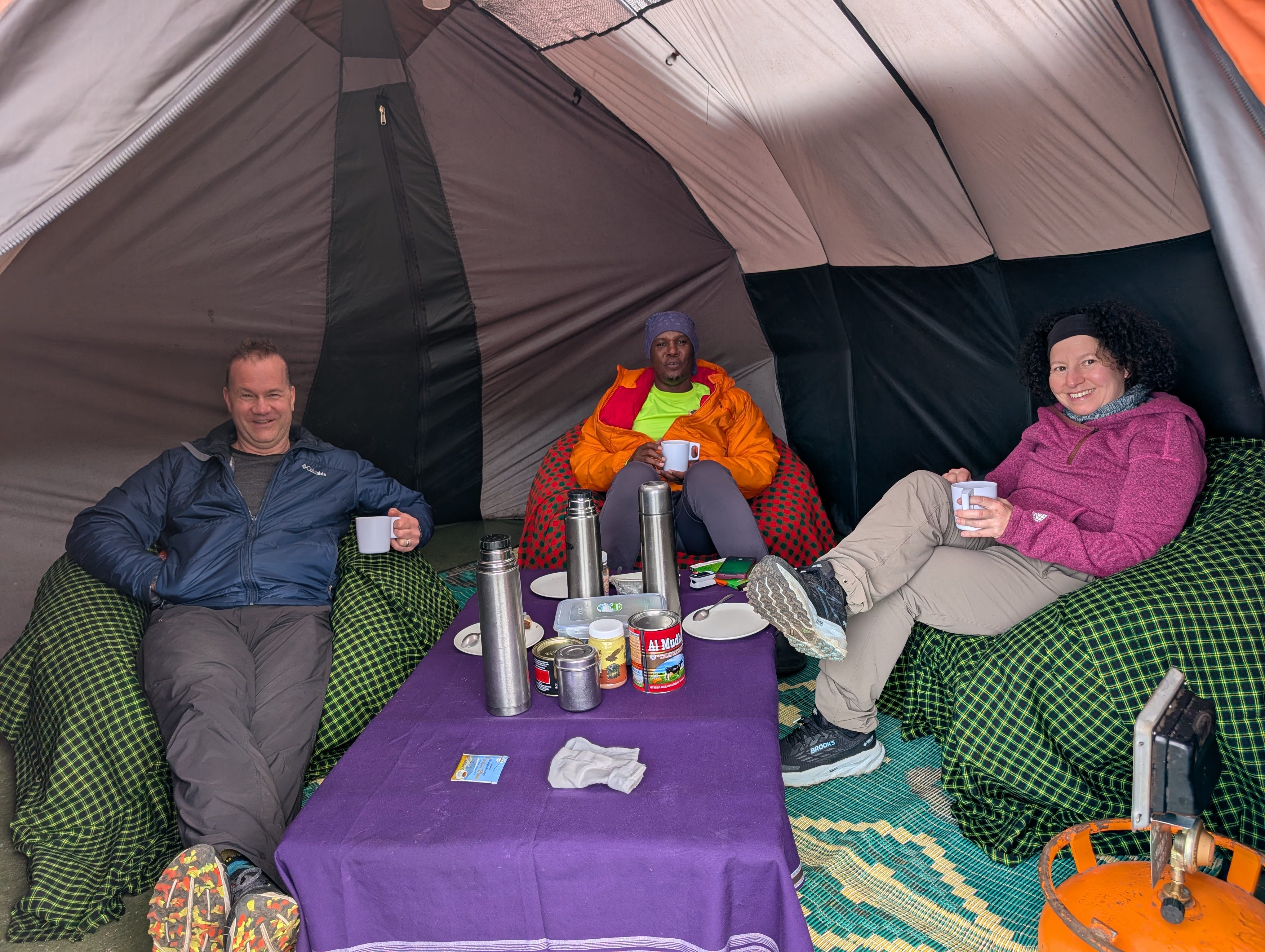
It’s day four. Marc and I are in the tent when we hear the call from outside from one of our porters that it’s tea time. He looks annoyed. Same complaint as the day before. Why do we have to interrupt our downtime for ‘this’? Why can’t it wait?
What was ‘this’? Each day after the hike, lunch, and some downtime, we had tea time. We got our pulse ox checked, debriefed on the day, had snacks - and hey, some tea - before dinner.
Marc wasn’t wrong. Pandel, our head guide, could have gotten what he needed at dinner instead. But instead I was on the receiving end where he wasn’t complaining at me, but to me about this situation. So now, I have to figure this out.
I’m an accountability coach. I get paid to help people have hard conversations instead of avoiding it. And on that mountain, I couldn’t convince my husband to have a two-minute chat with our guide.
There’s nothing like being alone in your thoughts on a mountain in the middle of Africa to get you thinking about ALL OF THE THINGS. Most of the trail is single file. As I mentioned last week, my main goal was to follow Pandel’s pace and not be told to slow down.
Somewhere on that trail, I realized I never decided to be the person who handles these things. Then the anger started to build. Complaining to me instead of the person who could fix it wasn’t about Marc being difficult. It was about me enabling the pattern for 23+ years.
There’s a difference between being the one who’s always counted on and consciously deciding how you’re going to show up for someone — between being there for your partner and quietly taking over everything for them. It’s a fine line, and it’s hard to know when you’ve crossed it. Every relationship has a natural cadence, where one person zigs and the other zags. It works until it doesn’t.

That was the part that drove why I was so angry. Not “why is Marc annoyed about tea time.” It was closer to: “For fuck’s sake, Jill. You built this. Now you have to figure out how to unwind it.”
Five weeks after we got back, I met up with a close friend the same week my mom had her fall — feeling like I was getting the shit kicked out of me. She didn’t hesitate. “Well, Jill. You are the one we all come to when we need advice on something. Because yeah — you’re THAT person.”
When I had that realization, I thought to myself that I don’t want to be an accountability coach in my marriage. Again not something forced upon me, but a dynamic that started to function on autopilot. Woohoo!
March had been its own kind of stress: my mom’s Parkinson’s symptoms increasing, and coming to the realization about what it means. Having hard conversations with my dad and my sister. In one session with our therapist that month, we each picked two words to describe where we were at. I said I was tired and burnt out. I then elaborated on what I call being in the “shitty shit shit” phase. I knew that phase wasn’t going to last forever but it still sucked.
Marc said “I know that Jill manages to get through everything. And I think that’s always going to be the case”. I have no doubt it was meant as a compliment. It also meant he’d stopped imagining another way it could go — not because he didn’t care, but because nothing in 23 years had ever asked him to.
When our therapist once asked us to estimate how the emotional and social load was split between us, she guessed 80/20. Marc corrected her. “More like 95/5,” he said. “Jill does 95. I do 5.”
OK, let me explain. Doing it myself is just easier than explaining it to someone else. Sound familiar? So what turns into a “sometimes” thing eventually becomes an “all of the time” thing. It’s not a conscious decision but it’s about being more productive. It goes both ways. Marc does certain things that play to his strengths. We both do this thing called “over-functioning.” In other words, we kick the can down the road in the interest of expediency.
So instead of finding the right person to own a problem, or making someone else take it on, you just fix it yourself.
Tea time had an end point too — the trip ended eventually. What it didn’t have was any reason Marc couldn’t handle it himself. He could have talked to Pandel. He just never had to because by then I’d already made sure he wouldn’t need to.
Flipping the over-functioning on its head, you can look at the situation with my mom’s hospitalization after her fall. My sister Lisa and I divided things up by what actually made sense: she’s proximate to our parents, so she’s in charge of everything locally. I’m in Seattle, so I took the insurance, the financial piece, the discharge coordination, and any additional research.
It doesn’t have to be someone who matters most for the same instinct to kick in. Friends and former colleagues ask me for advice on writing regularly all the time. I’m not an expert — just consistent, for 3+ years. I have a rule that I’ll make time for these conversations for people genuinely curious about what they want to write and why, not the ones chasing followers. Writing regularly is lonely enough. You rarely know if any of it is resonating, so I’d rather spend the time with someone who has something thoughtful to say.
Making commitments to people and being the person who can always be counted on look the same. They’re not. One comes with a specific cause along with an end point, implied or not. The other just keeps going until you realize it is YOU by default. What started out as “I’ll handle it” morphs into something more ongoing and open-ended.
What I’m Doing Differently
Here are 3 things I’ve been implementing or trying to implement for some time now (even before this recent realization):
Did I decide this task was mine, or did it just become mine because I never stopped it? Marc could have talked to Pandel himself. I made it easier for him not to.
What am I getting out of the over-functioning? I had to own that it is about control and that part of me enjoyed that. That made it easier for it to become a habit and something to hold on to.
I will give myself credit that I started letting the “milk spill” for a few years now. I used to try and fix things before things went sideways but then you learn that no one sees the problem and you get stuck in fix-it girl mode in perpetuity. Let the milk spill and let others learn. Those folks may have a better way to prevent things from going wrong. You may know this as ‘delegation’. ;-)
This Week, Try This
Next time something lands in your lap, pause. Ask whether you’re choosing it on purpose or grabbing it out of habit. If it’s real, say so out loud. If it’s not, assign it to someone else and see what happens.
If you’ve stopped asking which one you’re doing, that’s the pattern Go Long’s 1:1 coaching is built to help you name and change.
What are you carrying right now because you decided to vs because you never noticed it becoming yours?
I worked with a parent coach/therapist who advised me to look at specific behaviors of mine as a parent with my oldest child and determine whether they are accommodations or supports. Accommodations are things I do to make life easier for other people when they should be doing it for themselves - similar to you handling things for Marc on your hike. It was excellent advice for me as a parent, and I've also been able to use it when I look at my interactions and behaviors with friends, extended family members, and just being out in the world.
This resonated quite a bit! Good suggestions!